2. ECONOMIC DATA – AKOYA PEARL MARKET VALUE
PRESS KIT

2.1 Declining Production and an Increasingly Selective Supply
2.2 Rapid Price Growth: A Dynamic Surpassing Gold
2.3 Kobe: A Strategic Hub of the Global Market
2.4 Global Demand and Comparison with Other Pearl Market
2.5 Exports and International Recognition
2.6 Future Outlook: Value, Sustainability, and Communication
2.1 Declining Production
and an Increasingly Selective Supply
2.2 Rapid Price Growth:
A Dynamic Surpassing Gold
2.3 Kobe: A Strategic Hub of the Global Market
2.4 Global Demand and Comparison
with Other Pearl Markets
2.5 Exports and International Recognition
2.6 Future Outlook: Value, Sustainability,
and Communication
The main Akoya pearl production areas remain Japan’s historic regions: Mie (Ise-Shima), Ehime (Uwajima), and Nagasaki (Iki and Tsushima), with smaller contributions from Kumamoto and Ōita. Since 2019, however, the sector has been severely impacted by mass mortality among Akoya oysters, a phenomenon linked to the deterioration of the marine environment, rising water temperatures, and the gradual decline in the number of pearl farmers.
These factors have caused a collapse in production, particularly of high-quality pearls, making Akoya pearls with diameters over 8 mm, thick nacre, and no color treatments increasingly rare. While the most common sizes still range between 6 and 9 mm, value is determined above all by luster, nacre quality, absence of blemishes, shape, and color-attributes that are becoming ever more difficult to achieve.
Against the backdrop of limited supply, international demand continues to grow, driven in particular by Asian markets and China. Since 2023, Akoya pearl prices have seen increases that in some cases have doubled previous levels, with a rate of growth that has even outpaced that of gold.
Akoya pearls are no longer perceived solely as classic ceremonial jewelry, but as rare and enduring assets capable of maintaining and increasing their value over time. This shift in perception has helped strengthen their positioning within the segment of conscious and sustainable luxury.
Within the distribution system, Kobe continues to play a central role. Long known as the “Pearl City,” it is the world’s primary hub for pearl selection, processing, and grading. Not only Japanese Akoya pearls converge here, but also pearls of international origin, reinforcing Japan’s role as a nerve center of global trade.
The flow follows a well-defined structure: farming → harvesting and processing → B2B and B2C distribution.
Japanese institutions, including the Ministry of Agriculture, Forestry and Fisheries, actively support the sector through international trade fairs and business-to-business meetings, promoting fair commercial practices and the enhancement of quality.
In the international context, Akoya pearls stand alongside the other two major families of marine pearls: black pearls (Tahitian) and South Sea pearls, renowned for their larger sizes and golden or silvery hues. These are complemented by freshwater pearls, produced mainly in China, characterized by wide availability and more accessible prices.
The gradual decline in Akoya production is fostering a polarization of the market: on one side, low-cost freshwater pearls; on the other, increasingly rare high-end Akoya pearls destined for a knowledgeable and discerning clientele. In this scenario, Japan maintains a leadership position, processing approximately 70% of the world’s marine pearls, including non-Akoya varieties.
After the collapse in 2020 caused by the pandemic, when exports fell to 7.6 billion yen, the sector experienced an extraordinary recovery, reaching approximately 45.6 billion yen in 2023. Hong Kong, the United States, and China remain the main destination markets, supported by the return of international trade fairs, global recognition of Japanese quality, and the favorable impact of the weak yen.
Looking ahead, all indicators suggest that high-quality Akoya pearls will become increasingly rare and valuable. Climate change and labor shortages make a rapid recovery in production unlikely, further reinforcing the value of the finest pearls.
The primary challenge will be to communicate clearly the differences between Akoya pearls and other varieties, highlighting the craftsmanship, traditional techniques, and sustainability of the Japanese production process. In a market increasingly crowded with more affordable alternatives, the true strength of Akoya pearls will lie in their history, authenticity, and uncompromising quality-elements that continue to make them one of the most sought-after organic gems in the world.
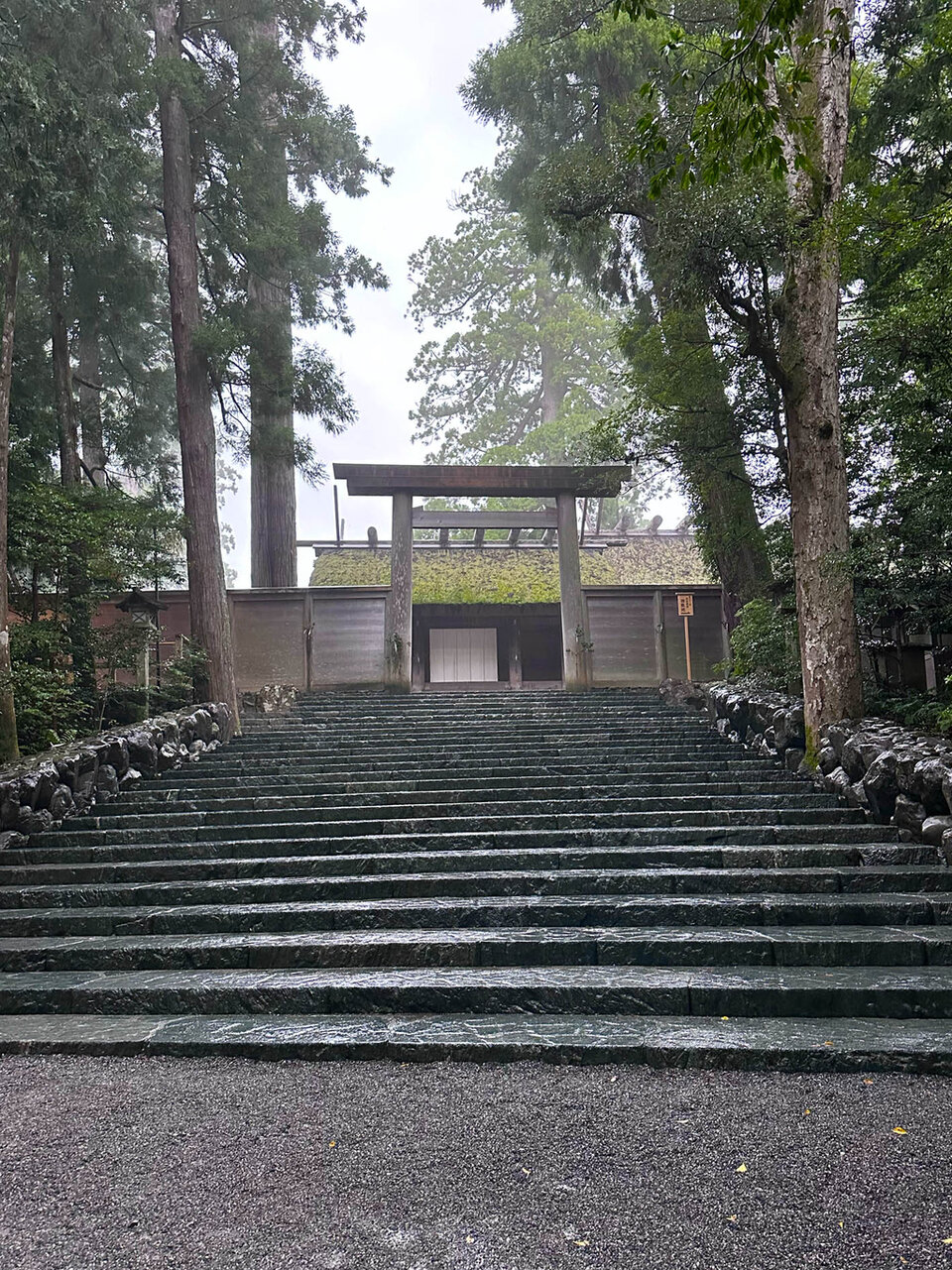
The Grand Ise Shrine, dating back to 690 AD and dedicated to Amaterasu, the Sun Goddess.

A project by Preziosa Magazine
Texts by Silvio Ciniglio